




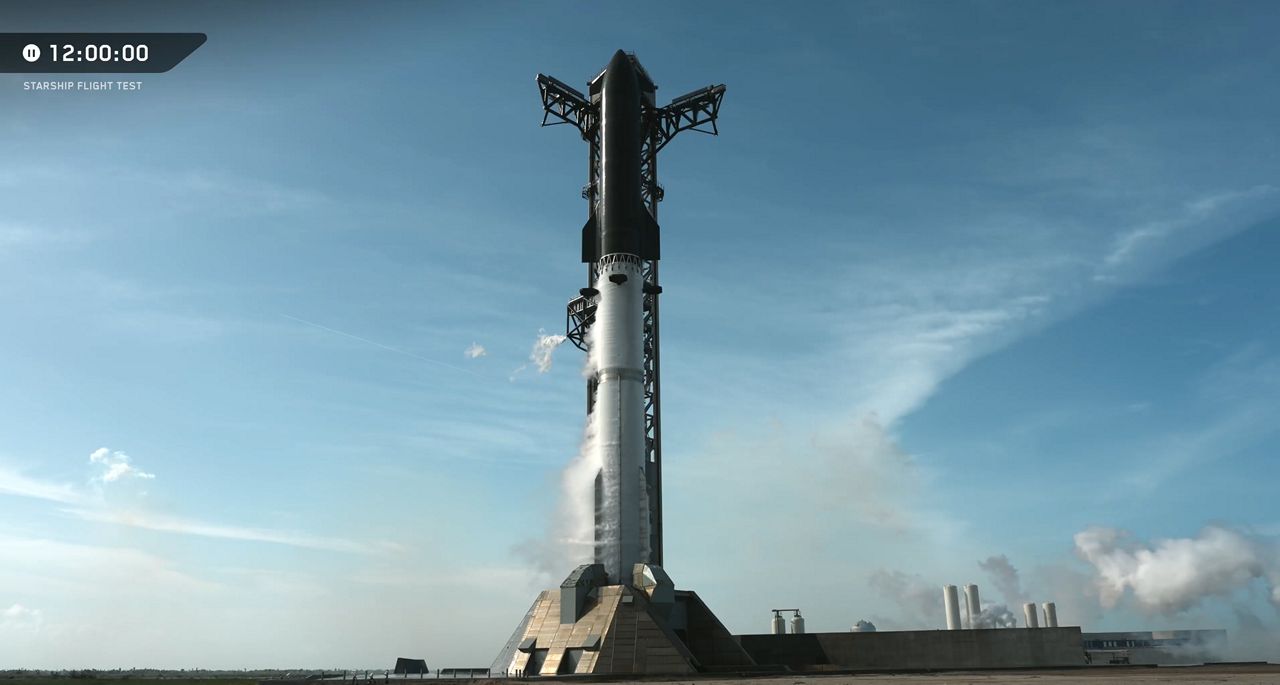
BOCA CHICA BEACH, Texas — SpaceX will try again to launch Starship as early as Thursday. The launch window opens at 6:45 p.m. Eastern Time.
As the countdown clock reached zero and flames were seen coming from the bottom of SpaceX's massive Starship rocket, a warning system triggered a hold during Thursday night's launch attempt.
What You Need To Know
- Chopsticks will not catch Super Heavy rocket booster for 13th test
- Starship is the spacecraft, and the Super Heavy is the rocket booster
- When they are stacked together, they are called Starship
- SpaceX made corrections to the issues discovered in the last mission
- Get more space coverage here ▶
- 🔻Scroll down to learn about the Starship's test flights🔻
As the countdown clock reached zero and flames were seen coming from the bottom of SpaceX's massive Starship rocket, a warning system triggered a hold during the original July 16 launch attempt.
The uncrewed Starship, which stands 407 feet (124 meters) tall, was all set to take off from SpaceX’s Starbase facility in Boca Chica, Texas, the company stated.
The 90-minute launch window opened at 6:45 p.m. ET for this Starship’s suborbital test flight, but as the countdown clock reached zero and flames and smoke were seen, the rocket that might one day play a part in returning humans to the moon did not leave the launch pad.
During a livefeed, SpaceX Communications manager Daniel Huot said a hold was triggered from the booster. The triggered hold scrubbed any further attempts at liftoff for Thursday night, he stated.
SpaceX founder Elon Musk took to X and explained that some of the 33 Raptor 3 engines did not fire, thus triggering an automatic launch abort to the mission.
After the aborted launch attempt, crews offloaded the fuel from the rocket, and engineers and technicians went over data to determine what exactly went wrong.
Starship is the spacecraft, and Super Heavy is the rocket booster. When assembled, they are jointly called Starship.
This new generation Starship is 10 feet (3 meters) taller than the previous versions that were tested before flight 12.
- Scroll down to see the Starship flight tests timeline and the issues witnessed in the last test.
What was expected from the 13th test flight
SpaceX shared information about what was expected for the flight. The following information below should still be in place for the second attempt of the 13th test flight.
The Starship, expected to be part of NASA’s Artemis III mission next year, will demonstrate what people anticipate from it.
The Super Heavy booster will be taken through its paces.
“The booster’s primary test objective will be executing a successful launch, ascent, stage separation, boostback burn, and landing burn at an offshore landing point in the Gulf of America,” the company stated.
Which means it will not be caught by the launch tower’s metal arms, known as the chopsticks.
Hours before the flight, Dr. Don Platt, director of Florida Tech's Spaceport Education, shared with Spectrum News some of the things people can look for during the Starship test launch.
"Well, one of the first things that you should look at is, even during the launch itself and when the booster is still fairly low, you can see all of those lit engines on the bottom of the rocket. And just look to see that all of them are lit. For a few of these missions, we've seen one or two that are dark," he said. "And so that means those rocket engines are not operational."
Platt said Starship is the biggest rocket ever developed and called it a complex vehicle.
"Two stages that are very different from one another. New rocket propellant systems that have really not been used that often before. So there's a huge amount of development that has gone into getting us to this point. You know, there certainly have been a few hiccups here and there, but basically their philosophy is to build it and then test it," he said.
During the last test, the Super Heavy booster experienced issues and could not re-light some of the Raptor 3 engines after stage separation.
For the 13th test launch, the newest booster had hardware modifications to improve the re-light system, stated SpaceX.
The company did not state how many of the Raptor 3 engines will be used for its flip and water landing in the Gulf; the booster has a total of 33 Raptor engines.
Platt also shared what people should be on the look out for during the launch.
Starship’s upper stage, which one day astronauts may use to go to the moon in the Artemis IV mission, will have its own set of goals to accomplish.
“The Starship upper stage’s primary objectives include the deployment of 20 Starlink V3 satellites, a relight of a single Raptor engine while in space, and another controlled entry, descent, and splashdown in the Indian Ocean. There have also been several modifications to Starship’s propulsion system to address the engine out issue experienced on the previous flight,” the Texas-based company revealed.
And these are actual V3 Starlink satellites, not the simulators that were seen in previous tests.
These 20 Starlink satellites have their own tasks to perform. They will extend their solar arrays and antennas and attempt to connect to the Starlink constellation, which has more than 9,000 satellites in operational orbit.
The 20 Starlink satellites will be in the same suborbital orbit as Starship, and six of them are modified with cameras to scan the craft’s heat shield and send photos back down to mission control.
However, all of them will eventually burn up on re-entry 20 minutes after deployment.
The heat shield will play a big part in the flight 13 test.
“Several upgrades and experiments related to Starship’s heat shield will also be tested to continue iteration towards a fully and rapidly reusable design. Multiple tiles will be attached to the metallic side of Starship’s aft flaps along with modified tiles and attachment mechanisms in the heat shield covering the aft skirt to gather flight data on different attachment options. Finally, Starship’s heat shield will have load sensing tiles to take measurements as the vehicle experiences higher dynamic pressure on ascent than previous flights, putting added stress on the tile attachments in exchange for increased payload to orbit capability.”
Starship is expected to splash down in the Indian Ocean once it reenters Earth's atmosphere.
Starship’s Test Flights
Take a look back at all 12 test flights simultaneously ahead of Thursday's 13th launch.
Platt gave a brief recap of the last test flight and said that while things worked out well, there were a few problems too.
"So the key element there was the fact that pretty much everything was a success. You know, they were able to get the, the Starship vehicle itself off over into the Indian Ocean and did a successful demonstration landing there. They deployed some fake satellites and, their heat shield worked great. And, the only problem they had was the super booster was supposed to come back to a controlled landing in the Gulf, and it didn't," he said.
He added, "And so the FAA required them to do an investigation of that. And so that held things up a little bit. And that's why it's a little bit longer between that flight and this one."
Platt also said that SpaceX would need to have its first orbital test flight, the 14th test, before heading to Florida and launching the 15th one. SpaceX has stated that if all goes well, the Sunshine State might just see a Starship launch later this year.
Learn more about the ship’s test flight history through this digital timeline.
-

